To estimate how much yarn you need for a crochet blanket, divide the blanket’s area by the area of a swatch. Multiply by the yarn used in the swatch, add a reserve, then divide by the amount per skein and round up.
Estimate yarn from your swatch
1. Measure the blanket and swatch
Choose a finished width and length from the Crochet Blanket Size Chart or measure a blanket you like. If you’re estimating a different border separately, use the center’s dimensions for your main calculation.
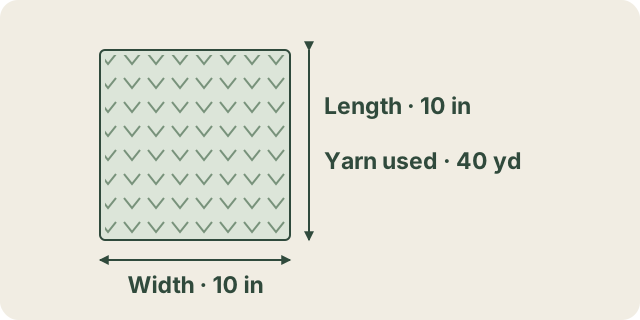
Make a swatch using the project’s yarn, hook, and stitch pattern. Include several complete repeats so the sample captures both dense and open areas. Wash and block it as you would the blanket, then measure the dry fabric flat without pulling it. Record the full width and length of the same fabric whose yarn you measure.
Measure yarn in yards, meters, or grams
- By length. Unravel the measured swatch and measure its yarn without stretching it. Keep track of the tails so a starting or finishing tail does not get multiplied into every swatch-sized area.
- By weight. Weigh the dry swatch and use grams for both swatch consumption and net weight per skein. Use a bigger swatch if the sample is too light for your scale to measure reliably.
- From grams to yards. Divide the label yardage by the net grams, then multiply by the swatch weight. With 200 yd per 100 g, a 20 g swatch used about 40 yd.
Use the Crochet Gauge Calculator to estimate stitch and row counts. Gauge tells you how big the fabric will be. Swatch consumption tells you how much yarn that fabric uses.
2. Scale the swatch to the blanket
Use inches for every dimension or centimeters for every dimension. The area ratio comes out the same with either unit.
- Area = width × length. Calculate it for the blanket and the swatch.
- Scale factor = blanket area ÷ swatch area.
- Base yarn estimate = swatch yarn × scale factor.
Worked example for a 50 × 60 in throw
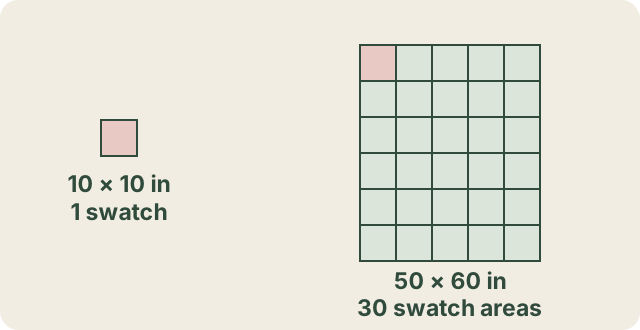
The throw covers 3,000 square inches. A 10 × 10 in swatch covers 100 square inches and uses 40 yd. Divide 3,000 by 100 to get 30, then multiply 40 yd by 30 for a 1,200 yd base estimate. This example assumes one stitch pattern across the entire throw.
3. Add an allowance and round up to whole skeins
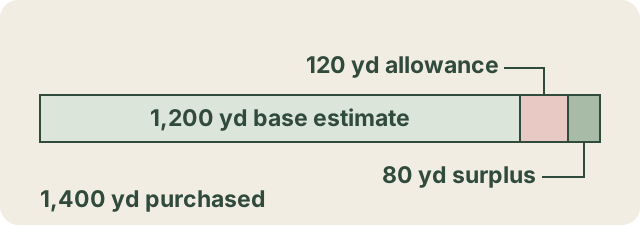
Required yarn = base estimate × (1 + allowance percentage ÷ 100). Use 10% for this example. Adjust the reserve for swatch uncertainty, yarn availability, and small finishing needs. Estimate a substantial border or join separately.
For the throw, 10% of 1,200 yd is 120 yd, bringing the total requirement to 1,320 yd. Divide by 200 yd per skein to get 6.6, then round up to 7 skeins. If the quotient is already a whole number, keep it.
Purchased yarn = whole skeins × yarn per skein. Seven skeins give you 1,400 yd. That is 80 yd above the 1,320 yd requirement, which already includes the allowance.
Illustrative yarn estimates by blanket size
All rows use the same hypothetical fabric and swatch. Assume 12 stitches and 10 rows per 4 in, a 10 × 10 in swatch that uses 40 yd, 10% extra, and skeins of 200 yd each. The yarn estimate comes from the measured consumption. Gauge alone cannot predict yardage.
| Blanket | Size (in) | Yards with extra | Skeins |
|---|---|---|---|
| Baby blanket | 36 × 40 | 633.6 | 4 |
| Lapghan | 36 × 48 | 760.32 | 4 |
| Throw | 50 × 60 | 1,320 | 7 |
| Twin | 65 × 90 | 2,574 | 13 |
The twin row uses a blanket size with extra mattress coverage. Use your own swatch results to make the shopping list.
What changes how much yarn a blanket uses?
- Yarn weight and construction. A different thickness or construction changes how the yarn fills an area. The weight category also tells you little about yards per skein. Read the label and make a new swatch when substituting. See the Craft Yarn Council’s yarn weight guidelines.
- Stitch pattern. Bobbles, cables, and open mesh put different amounts of yarn into the same area. Swatch a complete repeat. For a blanket with large sections in different stitches, estimate their areas separately.
- Tension. The same pattern can come out smaller or larger when you work more tightly or loosely. Measure your own swatch and check the width again after the first few full repeats.
- Hook size. A change in hook can alter loop size and fabric density. The effect on yarn per square inch depends on the stitch and tension, so measure again after changing hooks.
- Joins and finishing. For granny squares, multiply yarn per blocked motif by the count, then budget for seams and edging. Use the Granny Square Blanket Planning Guide to plan the layout.
Worked example for a contrasting border
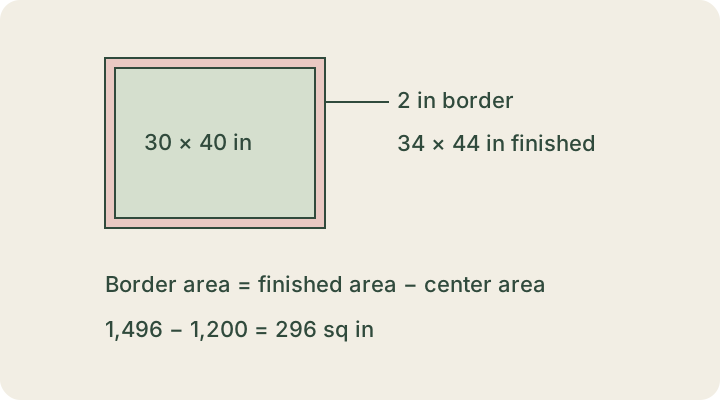
A 30 × 40 in center with a 2-inch border on every side finishes at 34 × 44 in. The border covers 34 × 44 − 30 × 40 = 296 square inches. If a 4 × 4 in swatch in the edging stitch uses 12 yd, estimate 296 ÷ 16 × 12 = 222 yd before allowance. Corners and stitch pickups can shift the result. For narrow edging, working a sample along a test edge can give a better guide.
Frequently asked questions
My pattern already gives yardage. Should I use that number?
Use the pattern’s yardage for your size when your yarn and gauge match. Check whether the amount is listed per color and includes the border. The Yarn Calculator can convert a known total to whole skeins.
How do I buy yarn for a striped blanket?
Estimate the amount for each color and divide each amount by that color’s label yardage. Round each color up separately. Keep contrast edging in its own estimate and check dye lots when buying multiple skeins.
Can I estimate from a blanket I’ve already started?
Yes, if the section you’ve worked represents the remaining fabric. Measure its area and subtract the yarn you have left from the amount you started with, using the same units. Scale that usage to the remaining area. Budget separately for later sections that use a different stitch.
Can I mix centimeters and yards?
Yes. Use centimeters for both fabric areas and yards for both swatch consumption and skein length. The area ratio is unitless. If your yarn label lists meters, convert the yarn lengths to the same unit before dividing.