For a 48 × 60 in blanket made with blocked 6 in squares, plan on 8 columns × 10 rows, or 80 squares, assuming no added seam width or outer border. With 4 in squares the same target takes 180 squares. With 5 in squares it takes 120 and finishes about 50 × 60 in.
Calculate your granny square blanket
Granny square blanket size chart
Pick a target width and length. Each cell shows columns × rows, the total number of squares, and the estimated finished size. These examples use blocked square sizes, zero added seam width, and zero border. Both dimensions meet or exceed the target under those assumptions.
| Target size | 4 in squares | 5 in squares | 6 in squares |
|---|---|---|---|
| Baby blanket 30 × 40 in | 80 squares 8 × 10 grid 32 × 40 in | 48 squares 6 × 8 grid 30 × 40 in | 35 squares 5 × 7 grid 30 × 42 in |
| Lap blanket 36 × 48 in | 108 squares 9 × 12 grid 36 × 48 in | 80 squares 8 × 10 grid 40 × 50 in | 48 squares 6 × 8 grid 36 × 48 in |
| Small throw 48 × 60 in | 180 squares 12 × 15 grid 48 × 60 in | 120 squares 10 × 12 grid 50 × 60 in | 80 squares 8 × 10 grid 48 × 60 in |
| Throw 50 × 60 in | 195 squares 13 × 15 grid 52 × 60 in | 120 squares 10 × 12 grid 50 × 60 in | 90 squares 9 × 10 grid 54 × 60 in |
These sizes are starting points. Compare general project dimensions in the Crochet Blanket Size Chart.
Compare three layouts for a baby blanket
For a 30 × 40 in target, 4 in squares add 2 in to the width, 5 in squares fit both dimensions, and 6 in squares add 2 in to the length. Tile size uses the same scale in all three diagrams.
8 × 10 = 80 squares
6 × 8 = 48 squares
5 × 7 = 35 squares
Measure the fabric you’ll actually join
Make a few motifs with your project yarn and hook. Wash or block them as you intend to treat the blanket. When they’re dry, lay them flat without stretching and measure from edge to edge across the middle in both directions. If one motif measures 5¾ in across and 6 in down, use separate width and length measurements.
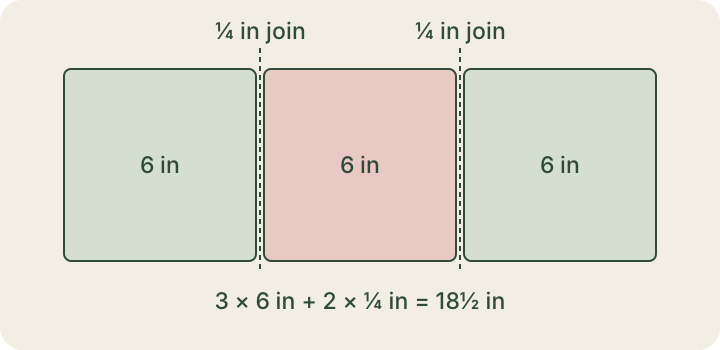
Join three sample motifs in a row and measure again. If three blocked 6 in squares measure 18½ in after joining, the two joins add ½ in altogether, or ¼ in per join. Check a vertical strip too if it uses a different joining method. For overlapping joins, measure a joined strip in each direction and divide its span by the number of motifs to estimate an effective size. Use that size with zero added seam width, and remeasure the assembled center before deciding on the border.
Calculate the center and check the finished size
The target is the overall size you want. First subtract twice the planned border width from each target dimension. Without added seams, divide each center dimension by the matching blocked motif dimension and round each count up. With a seam that adds width, use (center target + one seam) ÷ (motif size + one seam), then round up. Round the column and row counts before multiplying them.
To get the estimated finished size, multiply each count by its motif dimension, add one seam per gap, then add two border widths. A count that divides evenly can hit the target under the model. Rounding up adds fabric along that axis, and changes in tension or blocking can affect the actual dimensions.
Worked example with joins and a border
For a 50 × 60 in target, 5 in squares, ¼ in joins, and a 2 in border, the center target is 46 × 56 in. The width takes ⌈46.25 ÷ 5.25⌉ = 9 columns. The length takes ⌈56.25 ÷ 5.25⌉ = 11 rows. Buy or make 99 squares. With eight joins across and ten down, the finished estimate is 51 × 61½ in.
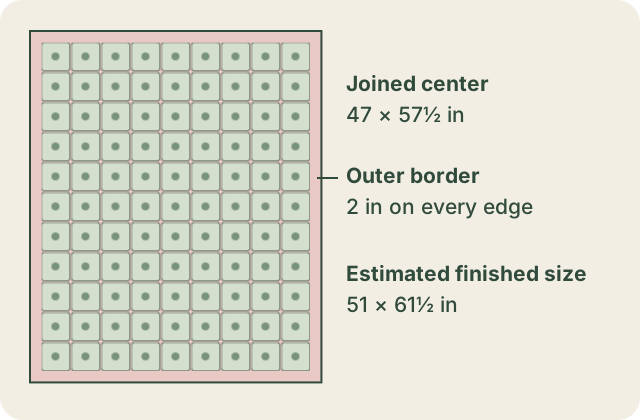
If the finished estimate is too large for a fixed space, compare a smaller border or motif. For the same 9 × 11 layout, a 1¼ in border would finish at about 49½ × 60 in. That is ½ in narrower than the original target and may suit a project that can come in slightly under.
Count colors before you buy yarn
Mark each color on a paper grid before joining, then count motifs by color. For an 8 × 10 checkerboard, each color needs 40 squares. Measure the yarn used by one motif of each color and allow separately for joining and edging. Use the Yarn Calculator to round up skeins for each color.