Finished blanket sizes in inches and centimeters
| Blanket | Inches | CM |
|---|---|---|
| Lovey | 12 × 12 | 30 × 30 |
| Stroller | 30 × 36 | 76 × 91 |
| Receiving | 40 × 40 | 102 × 102 |
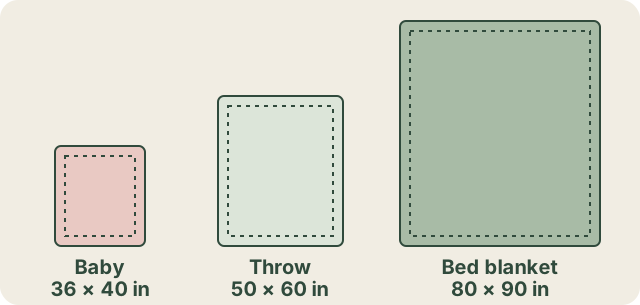
| Baby blanket | 36 × 40 | 91 × 102 |
| Crib size | 45 × 60 | 114 × 152 |
| Lapghan | 36 × 48 | 91 × 122 |
| Throw | 50 × 60 | 127 × 152 |
Use these dimensions as starting points. Pattern sizes vary, and your preferred coverage, gauge, blocking, and border can change the finished measurement. Centimeters are rounded to the nearest whole number.
Lovey and crib are pattern size labels. Keep loose blankets and soft items out of an infant’s sleep space, as advised by NIH Safe to Sleep.
Estimate yarn for your blanket
Twin, full, queen, and king crochet blanket sizes
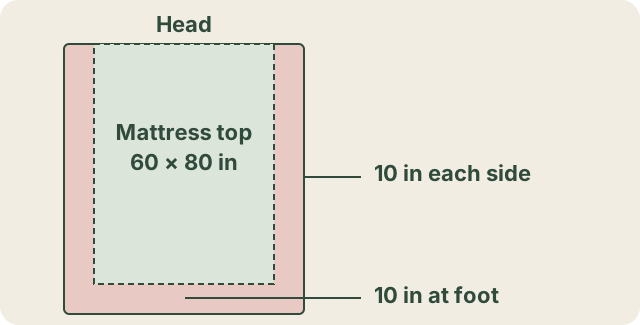
Measure the actual mattress first. Use its top dimensions for edge-to-edge coverage. Add as much drop as you want at each side and at the foot. Leave the head flush unless you want extra length there, too.
| Mattress | Inches | CM |
|---|---|---|
| Twin | 38 × 75 | 97 × 191 |
| Full | 54 × 75 | 137 × 191 |
| Queen | 60 × 80 | 152 × 203 |
| King | 76 × 80 | 193 × 203 |
| Blanket | Inches | CM |
|---|---|---|
| Twin | 65 × 90 | 165 × 229 |
| Full | 85 × 90 | 216 × 229 |
| Queen | 90 × 100 | 229 × 254 |
| King | 108 × 100 | 274 × 254 |
Example: a queen blanket with a 10-inch drop
For a 60 × 80 in mattress, add 10 in at each side for a width of 80 in. Add 10 in at the foot for a length of 90 in. The blanket target is 80 × 90 in (203 × 229 cm). If the bed has a footboard, measure how much room you have at the foot before adding any drop there.
How to choose and measure a finished size
For a couch project, measure a blanket you already reach for. A 36 × 48 in lapghan is a reasonable starting point for sitting in a chair. For more coverage while stretching out on a couch, try the 50 × 60 in throw. If the recipient is tall, check the length before buying yarn.
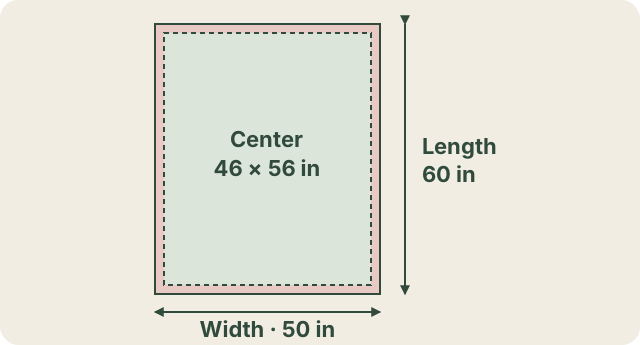
Lay the piece flat after washing or blocking and let it dry. With the blanket oriented as you’ll use it, measure width from left to right and length from top to bottom. Include the border in those measurements. Measure fringe separately if you want to record the size of the fabric itself.
Example: convert a throw to centimeters
Multiply each dimension by exactly 2.54. For a 50 × 60 in throw, 50 × 2.54 = 127 cm and 60 × 2.54 = 152.4 cm. The chart displays 127 × 152 cm. Keep 152.4 cm if you’re entering the measurement into a calculator.
Turn a blanket size into a project plan
Estimate yarn from a swatch
Say you’re making a 50 × 60 in throw in one stitch with no separate border. If a 10 × 10 in swatch uses 40 yd, the throw has 30 times the area and will use roughly 1,200 yd. With 10% extra, plan for 1,320 yd, or 7 skeins at 200 yd each.
Make your swatch with the yarn, hook, and stitch you plan to use. See how to measure crochet gauge and use the Blanket Yarn Calculator with your measurements. The blanket yardage guide shows how to estimate a contrasting border separately.
Plan a granny square layout
For a 50 × 60 in throw with a 1-inch border, aim for a 48 × 58 in joined center. With blocked 6-inch squares and a join that adds no measurable width, 8 squares across and 10 down give you 80 squares. The center comes out to 48 × 60 in, and the border brings the finished estimate to 50 × 62 in. Nine rows would fall short, so round up if you need to meet the target.
Join two test squares and measure the pair to see how the seam affects size. Use the Granny Square Calculator for your own measurements or compare motif sizes in the granny square blanket planning guide.
Sizing references
- Finished sizes from the Feather Stitch Blanket pattern and the Bernat Granny Rectangle Baby Blanket pattern.
- Mattress measurements from the Saatva mattress measuring guide.
- Exact inch-to-centimeter conversion from the NIST Guide to the SI.