Comparing motif sizes? See the size chart for 4, 5, and 6 in granny squares before entering your own measurements.
How to use the granny square calculator
Enter your finished blanket size, including any planned border. Choose a starting size from the Crochet Blanket Size Chart, then enter your blocked motif measurements. Blanket and square measurements can use different units.
Measure a finished square
Block a few representative motifs, let them dry, then measure them flat without stretching. Measure across the middle between opposite sides in both directions. If samples vary noticeably, compare their crochet gauge and decide whether to adjust your tension or hook before making the full set.
How joins and borders affect size
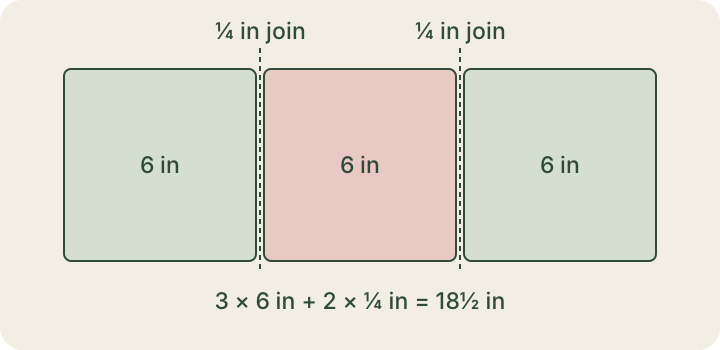
Join two sample squares and measure their combined width. If two 6-inch squares span 12¼ inches, enter ¼ inch as the added width per join. Three squares in a row have two joins. If the join overlaps or compresses the edges, estimate using an effective square size measured across several joined motifs and leave seam width at zero.
For each axis, subtract two border widths from the target. Divide the remaining span plus one seam by the square size plus one seam, then round up. The finished span is the square count multiplied by square size, plus one seam between neighbors and a border on either end.
Worked example
A 48 × 60 in blanket with 6 × 6 in squares and no extra seam or border needs 8 across × 10 down = 80 squares. Add a 1-inch border on every side and a quarter-inch seam between squares and the same layout finishes about 51¾ × 64¼ in. The minimum counts are still eight and ten because seven columns or nine rows would fall short.
A border can reduce the number of motifs needed. For a 48 × 60 in target with 6 in motifs, no added seam width, and a 3 in border on each side, the center is 42 × 54 in. That takes 7 columns × 9 rows, or 63 squares.
If the blanket must fit a fixed opening, check the difference from your target before buying yarn. Try a different motif size or border width if a whole extra row makes it too large.
Plan colors and yarn
Mark colorways on a sketch, count the squares of each design, and make one sample of each. Multiply the measured yarn per motif by the number of matching motifs. Estimate joining and border yarn separately, then use the Yarn Calculator to round up skeins by color. For a solid crocheted panel, use the Blanket Yarn Calculator with a representative swatch.
Common mistakes
Measure after blocking, since an unblocked square can change size. Count joins between motifs, and enter the border width for one side only. For a directional motif, keep its intended orientation when measuring width and height.
Frequently asked questions
Do I include the border in the target size?
Yes. Enter the desired finished dimensions, then specify the border width on one side. The calculator accounts for two sides on each axis.
Why is the estimated blanket larger than my target?
The calculator rounds up to whole squares. Adjust the motif size or border when you need a closer fit.
How do I measure a join that adds width?
Join and block a row of three sample motifs. If three 6-inch squares span 18½ inches together, the two seams add ½ inch in total. Enter ¼ inch per seam. If joins behave differently across and down, measure each direction and enter effective motif dimensions with the seam field set to zero.
How do I estimate yarn for joining and edging?
Measure yarn used on a sample seam and multiply by the number of seams. An 8 × 10 layout has 10 × 7 side-by-side connections and 8 × 9 connections between rows, for 142 total. For a border, work a sample length in the planned stitch and allow extra for corners.
Can I use rectangular motifs?
Yes. Give their width and height in the orientation you intend to join them. This layout assumes every motif is placed in that same orientation.