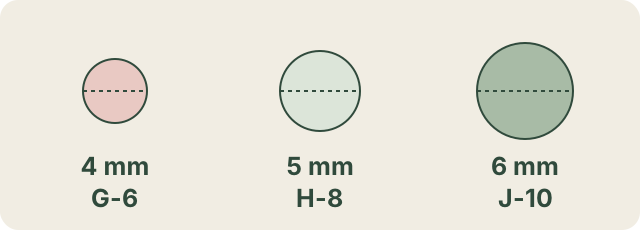
Start with the diameter stamped in millimeters. A 5 mm regular crochet hook is listed as US H-8 and historical UK 6 in the references below. If your hook or pattern gives only a letter or number, use the chart to find the possible diameter, then check the maker’s size information.
Regular crochet hook sizes in mm, US, and UK
Millimeters describe the shaft diameter. The US and historical UK columns give conventional labels from the cited references. “Unlisted” means the chart has no supported label to display for that diameter. Steel thread hooks use a separate system.
| Diameter (mm) | US label | Historical UK |
|---|---|---|
| 2 | Unlisted | 14 |
| 2.25 | B-1 | Unlisted |
| 2.5 | Unlisted | Unlisted |
| 2.75 | C-2 | Unlisted |
| 3 | Unlisted | 10 |
| 3.125 | D | Unlisted |
| 3.25 | D-3 | Unlisted |
| 3.5 | E-4 | 9 |
| 3.75 | F-5 | Unlisted |
| 4 | G-6 | 8 |
| 4.25 | G | Unlisted |
| 4.5 | 7 | Unlisted |
| 5 | H-8 | 6 |
| 5.25 | I | Unlisted |
| 5.5 | I-9 | 5 |
| 5.75 | J | Unlisted |
| 6 | J-10 | 4 |
| 6.5 | K-10½ | 3 |
| 7 | Unlisted | 2 |
| 8 | L-11 | 0 |
| 9 | M/N-13 | 00 |
| 10 | N/P-15 | 000 |
| 11.5 | P-16 | Unlisted |
| 12 | Unlisted | Unlisted |
| 15 | P/Q | Unlisted |
| 15.75 | Q | Unlisted |
| 16 | Q | Unlisted |
| 19 | S | Unlisted |
| 25 | T/U/X | Unlisted |
| 30 | T/X | Unlisted |
US labels follow the Craft Yarn Council’s regular-hook table. The selected historical UK numbers come from Inside Crochet, pages 96–97, hosted by Stylecraft.
When a letter or number has more than one meaning
The US reference lists G-6 at 4 mm and G at 4.25 mm. It includes Q on rows for 15, 15.75, and 16 mm. The Hook Size Converter shows all listed candidates for an ambiguous label. A metric search matches the diameter exactly. For example, 4.2 mm won’t return the 4.25 mm row.
Check the size system on older patterns. Historical UK 0, 00, and 000 refer to 8, 9, and 10 mm respectively in the cited chart. The number of zeros matters. Some older labels differ from the US reference. Inside Crochet lists US S at 20 mm, while the Craft Yarn Council lists S at 19 mm. Use the maker’s diameter if you can find it.
How to identify an unmarked crochet hook
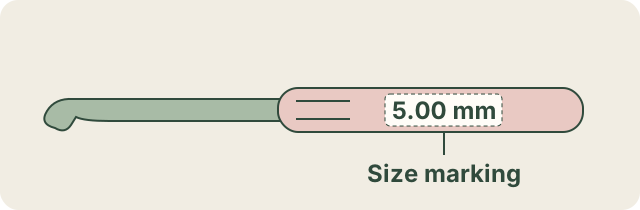
Check the thumb rest, handle, and any original packaging first. The printing can wear away, especially on the grip. A mark like 5.00 mm gives you a diameter to compare directly with the pattern.
- Find the straight section of shaft where yarn loops sit, behind the throat and before the thumb rest.
- Use a metric crochet hook gauge. Try the smallest marked notch that fits the shaft gently. With calipers, measure across a straight round section of the shaft and check the reading in millimeters.
- If the shaft tapers continuously, the reading falls between sizes, or the hook is worn, note the measurement and check the maker’s reference if available. Confirm the fit with a swatch.
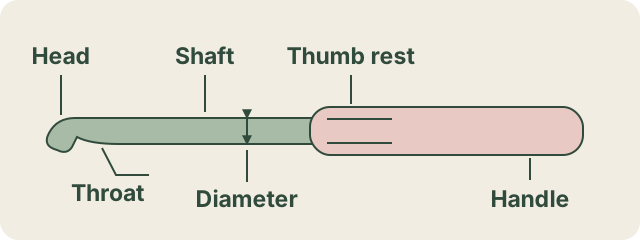
See Clover’s guide to sizing notches and Yarnspirations’ hook anatomy guide.
How to choose a crochet hook for your yarn
Use the pattern’s recommended diameter as your starting point. If you’re practicing without a pattern, a smooth category 4 medium yarn and a 5 mm hook are one practical combination. The Yarn Weight Chart explains the categories. Thicker yarn often takes a larger hook, but fiber, construction, and the fabric you want also matter. Craft Yarn Council hook-size guidelines by yarn weight.
Work a swatch with the project’s yarn and stitch pattern, then measure it after washing and drying as the pattern directs. If you have more stitches per inch than the pattern calls for, try a larger hook. If you have fewer, try a smaller one. Recheck the row gauge and feel of the fabric after changing hooks.
Follow the guide to measuring crochet gauge, then use the Crochet Gauge Calculator to estimate the stitches and rows for your project.
Frequently asked questions
Can I use a 5 mm hook when my pattern calls for 4.5 mm?
You can try it in a swatch. The larger hook can change stitch size, drape, and the finished dimensions. Compare the washed swatch with the pattern gauge before committing.
Why do two hooks marked 5 mm feel different?
The heads and throats can be shaped differently, and a smooth metal hook can feel different from a wood one. Your hands may also hold the grip differently. Work a small sample with each to see which gives you the fabric you want.
Does hook color tell me its size?
Some manufacturers color-code a set, but the color depends on the product line. For a loose hook from an unknown set, check the stamp or measure the shaft.
Can I use this chart for a numbered steel hook?
Use the manufacturer’s steel-hook guide. A steel hook and a regular hook can carry the same number while having different diameters.